
Lombard Epoxy Flooring installs basement floor epoxy in Lombard, IL, serving surrounding cities including Northlake, Westchester, Wood Dale, Hinsdale and Bensenville. In more than 20 years of coating DuPage County basements, the lesson we have learned most often is that the floor is the last step, not the first. Before any basement slab is ground or coated, we read it for past water, test it for moisture and make sure whatever caused a problem before is fixed.
A coated basement floor turns a gray, dusty slab into a clean, bright surface that is easy to mop, handles laundry spills and gym equipment, and makes the space feel finished. It also seals concrete dust, which is one of the main sources of grit in an unfinished basement. Those are real benefits, and they last only when the slab underneath is ready for a coating.
Basements are where coatings fail most often, because the slab sits in the ground and moisture can push up from below. Our approach is to answer the moisture question honestly, price any mitigation primer as its own line, and explain the warranty exclusions for moisture and hydrostatic pressure before the job is sold.
Reading the Basement Before Coating
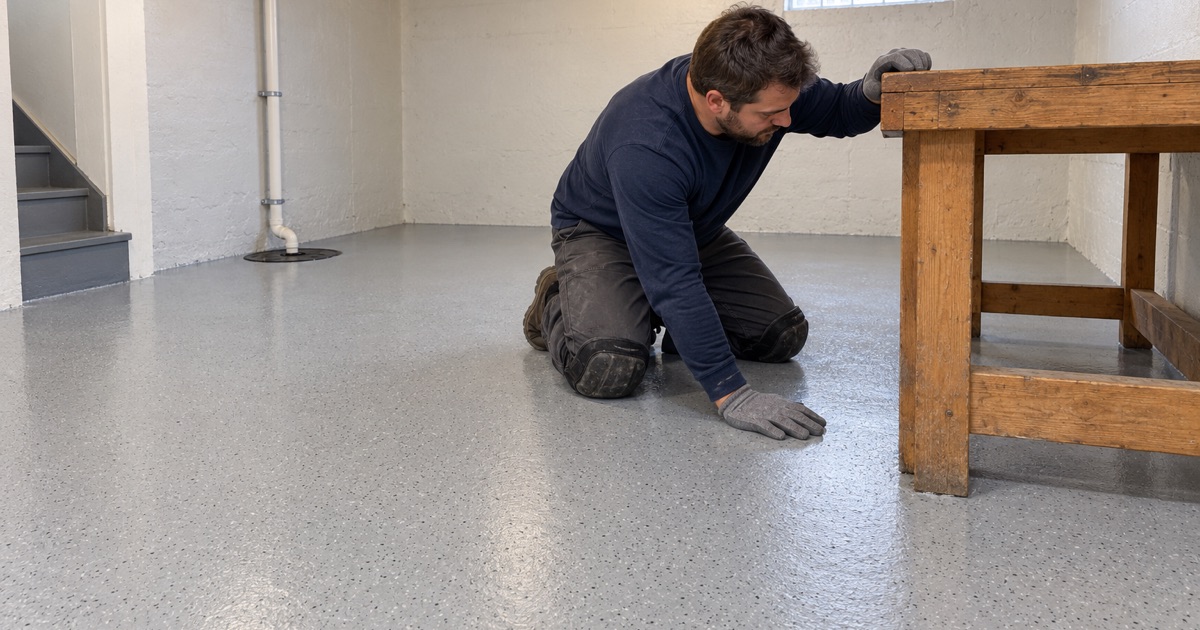
The Water History Comes First
We start by asking what the basement has been through. Has it taken water during a storm, backed up through the floor drain, or shown damp spots along the walls? Stains on the slab, rust on appliance feet, efflorescence and patched cracks all tell part of the story, and the answers change the plan.
The July 2010 storm and the April 2013 storm both flooded Lombard basements, including homes outside the mapped floodplain. A basement that took water in either one, or in any heavy rain since, may still have a drainage weakness that has not been fixed. A coating does not change that, so we ask before quoting.
Combined Sewers and Backups
Roughly a third of Lombard still has combined sewers, and in heavy storms some homes have seen water come up through the basement floor drain. The village runs a cost-share grant to help homeowners convert to an overhead sewer. If your basement has backed up before, the plumbing fix should come before the floor coating, since installing an overhead sewer may mean cutting into the slab.
We are happy to schedule the floor after the plumber is done. Coating first and then trenching through the new finish for pipe work wastes money and leaves a patch that never quite matches the rest of the floor.
Soils and Seasonal Water
Much of central Lombard sits on poorly drained glacial-till and silty clay loam soils, where seasonal water can stand close to the surface. That puts a basement slab in damp ground for part of every year, which is why we test rather than assume a slab is dry. A floor that reads dry in August may not in April.
Efflorescence and White Powder
White, chalky deposits on a basement floor or along the base of the walls are efflorescence: mineral salts carried to the surface by water moving through the concrete. They tell us moisture is active in that slab. We note where they appear, because those areas usually need a mitigation primer or a drainage fix before a coating will hold.
Testing the Slab for Moisture
Plastic Sheet Screening
The ASTM D4263 plastic sheet test is a quick first look. A square of plastic is taped to the slab and checked after a set time for condensation or darkening underneath. It cannot give a number, but it quickly separates obviously wet slabs from ones that need closer testing.
Calcium Chloride and Relative Humidity Testing
For a measured result, we use calcium chloride moisture vapor emission testing under ASTM F1869 or in-situ relative humidity probes under ASTM F2170. Those numbers are compared with the limits the coating manufacturer publishes for its system. The result goes into the written scope, so the price reflects the slab you actually have.
When a Moisture-Mitigation Primer Is Needed
If the readings are above what a standard primer can tolerate, a moisture-mitigation primer is applied first. It is designed to hold back vapor pressure from below so the coating above can bond. It adds cost, and we show that as its own line rather than leaving it out and hoping the slab dries.
A mitigation primer handles vapor, not liquid water. A slab with active seepage, a leaking crack or groundwater pushing up under pressure needs drainage work first, and no primer on the market is a substitute for a working sump or a sealed foundation.
Preparing an Older Basement Slab
Removing Paint, Patching and Tile Glue
Many basements in Lombard’s postwar houses have decades of floor paint, patch compound, old vinyl tile and its adhesive on the slab. All of it has to come off to sound concrete. We grind with diamond tooling and vacuum dust collection, and we price removal separately because it varies so much from one basement to the next.
Old black tile adhesive and some older floor tiles need careful handling, and we test what we find before grinding through it. If a material needs special handling, we tell you before the work starts rather than discovering it halfway through the job.
Cracks, Pitting and Uneven Areas
Cracks are routed and filled, pitted areas are patched, and uneven spots around old repairs are ground smooth. A basement slab often has a slope toward the floor drain, which we keep so water still runs where it should. Moving cracks are noted, since a coating will not hold a crack together.
Sump Pits, Drains and Ejector Pumps
The floor has to meet the sump pit, the floor drain and any ejector pump basin cleanly. We stop the coating at each one with a neat edge, keep grinding dust out of them with vacuum capture, and leave every lid and cover accessible. The pumps keep working and stay easy to service.
Choosing a System for the Room
Laundry Rooms
Laundry areas see water, detergent and the occasional washer leak. A coating with a flake or quartz broadcast and a textured topcoat gives grip underfoot and makes cleanup easy. We keep the floor’s slope toward the drain so spills run off rather than pooling under the machines.
Workshops and Storage
A workshop floor takes dropped tools, rolling carts and spilled finishes. A thicker 100% solids epoxy build with a chemical-resistant topcoat stands up to that and keeps sawdust from working into the concrete. A light color brightens a space that often has limited light.
Home Gyms and Family Rooms
Under a weight rack or treadmill, a heavier epoxy build handles point loads, and rubber mats can sit on top. In a family room, a decorative flake or metallic floor finishes the space and works well with area rugs. Because the coating does not insulate, rugs are the usual answer for a warmer feel.
What the Warranty Leaves Out
Almost every coating warranty excludes failures caused by moisture vapor transmission and hydrostatic pressure from under the slab. Those are the most common reasons basement floors fail, so we explain them first, before you sign. We also want to be clear about what a coating is not: it is not waterproofing, not flood protection, and not radon mitigation, which in Illinois is licensed through IEMA.
- 20+ Years Coating Concrete
- Moisture Tested Before Pricing
- Free Written Estimates