Lombard Epoxy Flooring installs flake epoxy floor systems in Lombard, IL, serving surrounding cities including Northlake, Westchester, Wood Dale, Hinsdale and Bensenville. With more than 20 years of grinding and coating local concrete, we install flake floors more than any other decorative system, because they combine good looks, texture underfoot and a surface that hides the dust and salt residue a working garage collects.
A flake floor is built in layers: a base coat over a ground slab, a broadcast of colored vinyl flakes into the wet base, and a clear topcoat that locks the flakes in and takes the wear. The flakes give the floor its color and pattern, hide small imperfections in the slab, and add a slight texture that helps with grip when the floor is wet.
The look comes from the flakes, but the life of the floor comes from the work underneath. Every flake system we install starts with mechanical grinding and a moisture test, and the proposal names the base, the broadcast, the topcoat, the number of coats and the finished thickness.
Flake Blends, Sizes and Coverage
Choosing a Blend
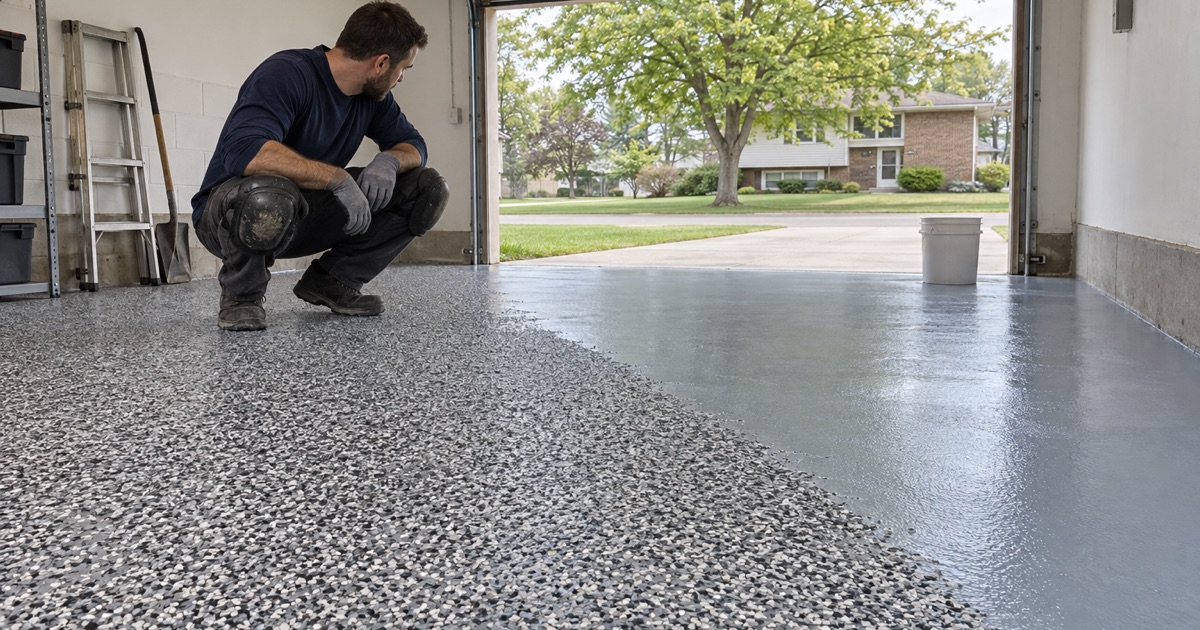
Flake blends mix several colors, from grays and tans to blues, reds and earth tones. Lighter blends brighten a garage or basement and hide dust well, while darker blends hide oil spots and tire marks. We bring physical samples so you can see the blend in your own lighting rather than on a screen.
Many owners pick a blend that picks up the color of the house trim, the cabinets or the walls. Neutral gray and tan blends are the most popular because they hide the widest range of dirt, while bolder blends suit a showroom garage, a game room or a business entry where the floor is meant to stand out.
Chip Size
Flakes come in several sizes. Smaller chips create a fine, granite-like look that reads as one even tone from a distance. Larger chips give a bolder, more speckled pattern. Chip size also slightly changes the texture once the topcoat is applied.
In a large garage or shop, a mid-size chip is usually the easiest to live with, because it reads as a pattern up close and as a calm, even color from across the room. Very large chips make a strong statement in a smaller space but can look busy across a big open floor, so we lay out samples side by side before you decide.
Full Broadcast or Partial Scatter
In a full broadcast, flakes are thrown into the wet base until it is completely covered, giving a uniform look and the most durable, textured surface. A partial scatter leaves the colored base showing between flakes for a lighter, more open pattern. Most garages get a full broadcast because it holds up better to wear and hides more.
The broadcast is done while the base is still wet, working across the floor in a steady pattern so coverage is even from wall to wall. Once the base cures, the excess flake is scraped and vacuumed off, leaving only chips that are bonded into the base.
How a Flake Floor Is Built
Grinding and Repair
The slab is ground with diamond tooling to open the surface and remove sealers, oil and weak concrete. Cracks, spalls and salt-scaled areas are filled and ground flush. Grinding dust is captured at the machine with a vacuum so it stays out of the house and the floor drain.
The slab is also tested for moisture before the price is final. Garage slabs here are often poured without a vapor retarder, and moisture rising through the concrete can push a coating off from below no matter how good the flakes look on top. A high reading means a moisture-mitigation primer, priced as its own line.
Base Coat and Broadcast
A 100% solids epoxy or a polyaspartic base goes down next, often tinted to match the blend. While it is still wet, flakes are broadcast across the floor. After cure, the loose flakes are scraped and vacuumed so only bonded chips remain, and the surface is ready for the topcoat.
Clear Topcoat
The clear topcoat seals the flakes and gives the floor its wear and chemical resistance. In garages we usually use a polyaspartic topcoat, which resists yellowing in sunlight and stands up to tires, road salt and gasoline. The topcoat thickness can be adjusted for more texture or a smoother feel.
A thinner topcoat leaves the chip texture more pronounced, which gives more grip but makes the floor a little harder to sweep. A thicker topcoat fills in the texture for a smoother finish. We set it to how you use the space, and we can add an anti-slip additive near the door where snow and water collect.
Where Flake Floors Work Best
Garages
Flake floors are the most popular garage system we install. They hide salt residue and tire marks, give grip near the door where snow melts off the car, and stand up to dropped tools. In Lombard winters, the sealed topcoat keeps brine and rock salt on the surface, where it can be squeegeed out instead of soaking into the concrete.
Basements, Laundry Rooms and Workshops
In a basement, a flake floor adds texture underfoot and hides the dust that settles in a lower level. Laundry areas benefit from the grip, and workshops from the durability. The slab is tested for moisture first, and a mitigation primer is used where needed.
A flake floor also makes a basement easier to keep clean. Unsealed concrete sheds a fine dust that settles on everything stored nearby, while a sealed, chip-covered floor stops that dusting and wipes down quickly after a spill, whether it is detergent in the laundry area or finish in the workshop.
Commercial Spaces
Flake systems are also used in locker rooms, break rooms, showrooms and retail floors, where they offer a durable, easy-to-clean surface with some decorative interest. A commercial flake floor is usually built thicker and topped with a chemical-resistant topcoat.
- 20+ Years Coating Concrete
- Moisture Tested Before Pricing
- Free Written Estimates