
Lombard Epoxy Flooring provides concrete grinding in Lombard, IL, serving surrounding cities including Northlake, Westchester, Wood Dale, Hinsdale and Bensenville. Over more than 20 years, we have seen far more coatings fail from poor preparation than from bad resin, so every floor we coat is opened mechanically with diamond grinding or shot blasting, never with an acid etch.
Grinding removes the weak top layer of concrete, old sealers, paint, epoxy and adhesive, and leaves the slab with a clean, open texture that a coating can lock into. It also flattens small ridges and trowel marks, opens the pores for primers, and reveals cracks and repairs that need attention before anything goes down. We grind as a standalone service and as the first step of every coating and polishing job.
Why Mechanical Preparation Matters
Concrete Surface Profile
Coating manufacturers specify a concrete surface profile, described by the ICRI CSP 1-10 scale, from very light texture to heavy roughness. Thin coatings need a fine profile, while thick mortar and urethane cement systems need a deep one. Grinding and shot blasting let us hit the profile the product calls for and confirm it, which an acid wash cannot do.
Getting the profile right is not just about roughness. Too smooth and the coating has nothing to grip, too rough and a thin coat will not cover the peaks, leaving them exposed to wear. Matching the profile to the system is part of the written scope on every job.
Removing Laitance and Contaminants
The top of most slabs carries laitance, a weak, chalky layer of cement and fines that floats up when concrete is finished. Over time, garage and shop floors also soak up oil, tire residue and road salt. Grinding takes that contaminated layer off so the coating bonds to sound concrete rather than to a film that will let go.
Deep oil stains are a special case. Grinding removes the surface, but oil that has soaked well into a garage slab can keep wicking back up and stop a primer from bonding. We degrease and grind those spots harder, and where the contamination runs deep we use a primer made for oil-stained concrete and note it in the proposal.
Problems With Acid Etching
Acid etching reacts only with clean, bare cement. It does nothing to sealers, curing compounds or oil, it etches unevenly, and the rinse water carries residue toward floor drains, sumps and storm inlets. A floor that has been etched instead of ground is the most common reason we see garage coatings peeling within a few seasons.
The rinse step is a problem of its own. Acid residue and loosened material have to be washed off with plenty of water, and that water goes somewhere, often into the floor drain, the sump pit or out the garage door toward the storm sewer. A ground floor is cleaned with a vacuum instead, so nothing from the prep work leaves the room.
Grinding and Shot Blasting Methods
Diamond Grinding
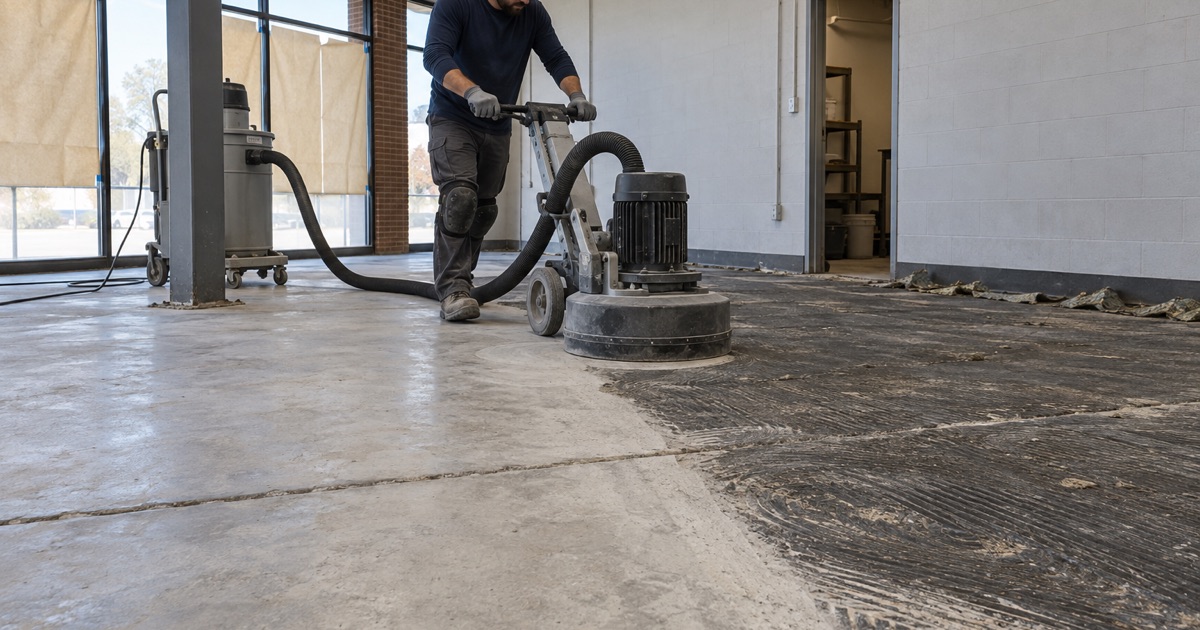
Planetary and single-head grinders use metal-bond diamond tooling to cut the surface. We choose the grit and bond to the hardness of the slab and the profile needed. Smaller edge grinders reach along walls, around posts and into corners, which is where an under-prepped floor usually fails first.
Diamond grinding is also the starting point for polished concrete, where the slab moves through finer grits until it shines. For coating prep, we stop at the coarse stage that gives the right profile and then move on to repairs.
Shot Blasting
On large commercial and industrial floors, a shot blaster fires steel shot at the concrete and recovers it in the same machine. It profiles big areas quickly and cleanly and is well suited to thicker coatings that need a deeper profile. Edges are still finished with grinders.
Shot blasting leaves a uniform, textured surface that shows clearly where the machine has passed, which makes it easy to confirm full coverage across a big warehouse or loading area. The blast depth is set by the shot size and travel speed, so the same machine can produce a light profile for a thin coating or a heavier one for a trowel-applied system.
Coating and Adhesive Removal
Old epoxy, paint, sealers, mastic and carpet glue are removed with aggressive tooling, and sometimes scrapers first. Removal is often the slowest part of the job, so we price it separately and look at the floor during the estimate to judge what is there.
Some old coatings come off in sheets once the grinder breaks the surface, while others are well bonded and have to be cut down layer by layer. A quick test patch during the estimate tells us which kind we are dealing with, so the removal line in the proposal reflects the real job rather than a guess.
Dust Control and Clean Work Areas
Vacuum Capture at the Machine
Every grinder we run is connected to an industrial vacuum that captures dust right at the cutting head. That keeps the air in the work area cleaner, protects the rest of the building, and means the dust ends up in a bag instead of washed toward a drain, sump or storm inlet. It is the standard approach for occupied homes and businesses.
Protecting the Rest of the Building
In attached garages and basements, we seal doors into living spaces and work from the outside in where possible. In offices, clinics and stores, we plan grinding for after hours or isolate the work area so the business can keep running.
After grinding, the floor is vacuumed again and wiped down so no dust is left on the surface when the primer goes on. Dust left on a ground slab acts like a bond breaker, which is why the cleanup between prep and coating gets the same attention as the grinding itself.
What Grinding Reveals
Cracks, Spalls and Joints
Once the surface is open, cracks, spalls, pitting and damaged joints become easy to see. We map them and repair them before priming, using fillers that are ground flush. Joints are filled or honored depending on how the slab moves.
Slabs That Should Not Be Coated
Sometimes grinding uncovers a slab that is too soft, too damaged or too wet to coat as planned. When that happens we stop and explain the options, which might include a moisture-mitigation primer, a repair mortar, or replacement of the slab, rather than coating over a problem.
- 20+ Years Coating Concrete
- Moisture Tested Before Pricing
- Free Written Estimates