
Lombard Epoxy Flooring handles concrete floor repair in Lombard, IL, serving surrounding cities including Northlake, Westchester, Wood Dale, Hinsdale and Bensenville. With more than 20 years of grinding and coating local slabs, we treat repair as part of every floor we install: cracks, spalls and failed coatings are mapped before the estimate is written, and the repairs are priced line by line so you can see what your slab needs.
Repair is what makes a coating last. A new floor laid over open cracks, crumbling patches and loose joint edges will crack and chip right where the old damage was, often within the first year. Fixing the slab first gives the coating a sound, continuous base, and it gives you a smoother, better-looking floor when the job is done.
We are also direct about the limits of repair. When a slab has heaved, settled badly or broken into pieces, surface repair is not enough, and we tell you that before any money is spent on a finish that the concrete underneath will not support.
Common Concrete Floor Damage We Repair
Cracks
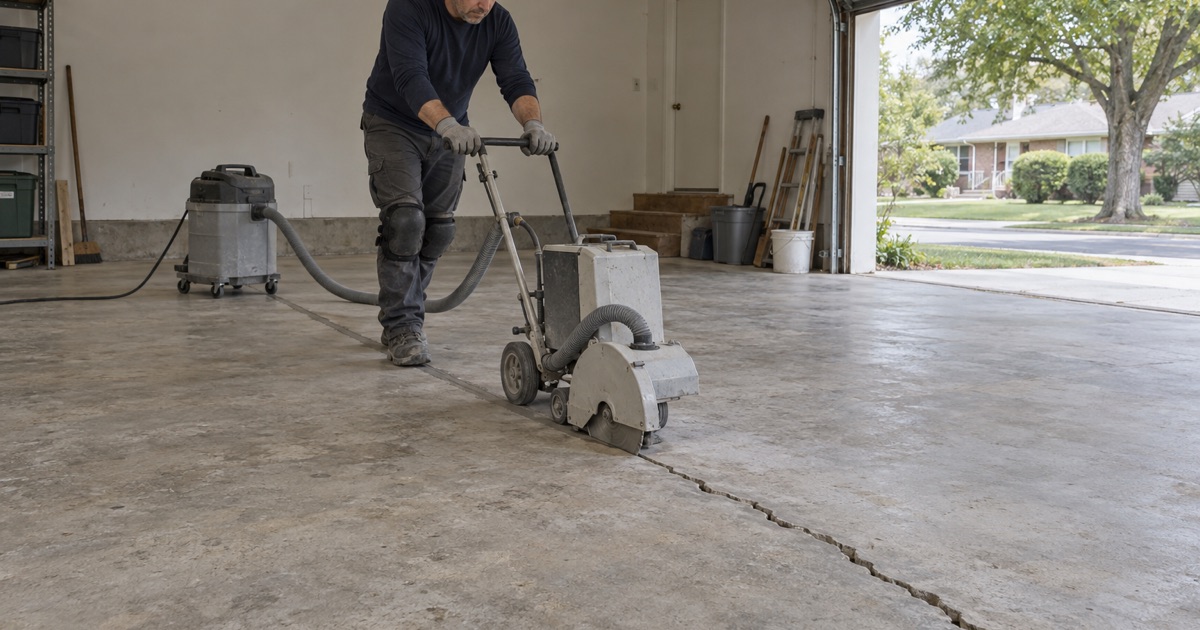
Most slabs crack as they shrink and as the ground beneath them moves. Hairline shrinkage cracks are usually stable, while wider cracks may still move with the seasons. We rout stable cracks open, clean them and fill them with an epoxy or polyurea crack filler, then grind the repair flush with the floor.
Wider or active cracks get a more flexible filler and are noted in the proposal, since movement can reflect through a coating over time. Where a crack runs under a load, like a car tire path or a forklift lane, we pay extra attention to the edges so they do not chip under traffic.
Spalls and Pitting
Spalls are areas where the surface has broken away, often around joints, at the garage door or where something heavy was dropped. Pitting appears as small holes across the surface. We grind out loose material, prime the area and fill it with an epoxy or polymer repair mortar, then grind it level with the surrounding slab.
Large or deep spalls are built up in layers so the repair cures solid all the way through. Shallow pitting across a whole floor can often be handled with a skim coat after grinding, which saves time compared with patching each hole one by one.
Salt Scaling on Garage Floors
Road salt and brine carried in on cars all winter soak into bare garage concrete, and repeated freezing and thawing breaks the top layer loose. The result is a rough, flaking surface, usually worst near the door and under the tire paths. We grind the scaled concrete back to sound material and resurface it before coating.
Once the slab is repaired, a sealed, chemical-resistant coating keeps salt water from soaking in again. Without that protection, a repaired garage floor will usually start scaling again after a few more winters of brine.
Joints, Edges and Transitions
Control Joints
Control joints are cut into slabs so they crack in a straight line where intended. Over time joint edges chip, and the joints fill with dirt and debris. We clean them out and either fill them with a semi-rigid joint filler for a smooth floor or keep them open and recut through the coating, depending on how much the slab moves.
In warehouses and shops, joint edges take a beating from hard forklift and pallet-jack wheels, which slam into any open gap and chip it wider. A semi-rigid filler installed flush with the surface supports those edges and stops the cycle, and it can be replaced later without disturbing the coating around it.
Garage Door Thresholds
The strip at the garage door takes the most abuse: salt, standing water, snow shovels and the edge of the door itself. It is often the most damaged part of the slab. We repair and reinforce that edge before coating so the floor does not start peeling where the car drives in.
Where the driveway meets the garage slab, the joint between them often opens up as the two pieces of concrete move separately. We fill and detail that transition so water and salt do not run under the edge of the new coating, which is one of the most common places a garage floor starts to lift.
Commercial Edges and Drains
In commercial spaces, damaged concrete around floor drains, trench drains and dock edges needs repair before coating. We rebuild those edges with repair mortars suited to the traffic and moisture they see, so the coating has a solid edge to terminate against.
Many commercial repairs have to be done quickly so a space can reopen. Fast-curing repair mortars and polyurea fillers let us patch, grind and coat in the same window, often overnight. We plan the repair materials around the schedule as well as the damage.
When Repair Is Not Enough
Heaved, Sunk or Broken Slabs
A slab that has lifted, dropped or split into loose sections has a problem below the surface: the base, drainage or soil underneath it. Surface repair and coating will not hold it together. In those cases we recommend replacement, or at least a structural evaluation, before any decorative work.
The signs are usually easy to see once the floor is clear: a step in the slab you can feel underfoot, a crack wide enough to fit a coin that keeps opening, or a section that rocks or sounds hollow when tapped. Any of those means the concrete is not stable enough to hold a coating, and we would rather tell you now than after the floor is installed.
Moisture and Water Problems
Repeated cracking and efflorescence can point to water moving through or under the slab. Basements with a seepage history need the water solved first, since repairs and coatings will not hold back liquid water or hydrostatic pressure. We test for moisture before quoting the full job.
Permits and Replacement Work
Replacing a slab is a larger job than repair, and in Lombard permit questions go to the village Building Division. We check before scheduling anything beyond surface repair, so the work is done the right way from the start.
- 20+ Years Coating Concrete
- Moisture Tested Before Pricing
- Free Written Estimates