Lombard Epoxy Flooring grinds and finishes polished concrete floors in Lombard, IL, serving surrounding cities including Northlake, Westchester, Wood Dale, Hinsdale and Bensenville. After more than 20 years working on DuPage County slabs, we know that a polished floor is only as good as the concrete it starts with, so every job begins with test passes on your slab rather than a promise made from a sample board.
Polished concrete turns the slab itself into the finished floor. Instead of laying a coating on top, we grind the surface in progressively finer stages, harden it with a densifier and polish it until it reflects light. There is nothing to peel, nothing to blister and no wax to strip, which makes it a strong choice for retail floors, offices, showrooms, lofts and some basements.
It is not the right choice for every floor. Slabs that see constant oil, harsh chemicals or standing water are usually better off with a resin coating, and we say so during the estimate rather than polishing a floor that will stain in its first month of use.
How a Polished Concrete Floor Is Made
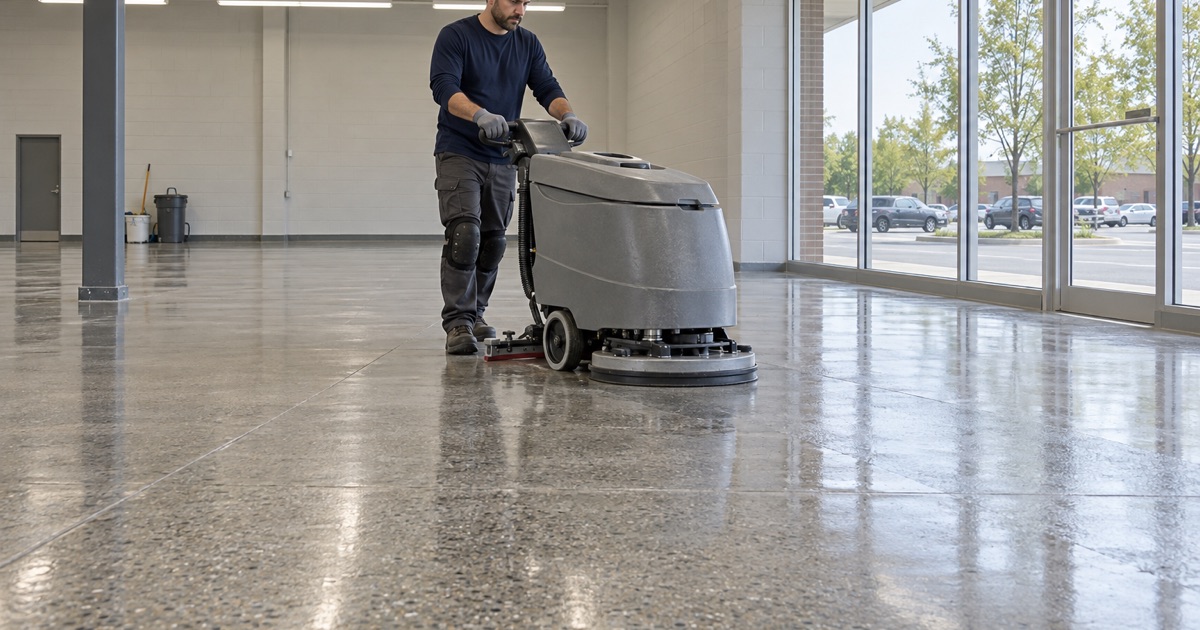
Coarse Grinding to Flatten and Open the Slab
The first passes use coarse metal-bond diamonds to remove the surface layer, flatten out trowel marks and minor high spots, and open the concrete to the depth you have chosen. This is where existing sealers, adhesives and coatings are taken off, and where any surprises in the slab show up. The grinder runs with a vacuum attached at the machine, so dust is captured rather than swept or rinsed into a floor drain.
How deep we grind at this stage sets the look of the whole floor. A light pass stays in the cream at the surface, while more passes cut down into the sand and stone that make up the slab. Once the depth is chosen it cannot be undone, so we agree on it with you from test areas first.
Densifying With Lithium Silicate
After the coarse grinding, we apply a lithium silicate densifier, which soaks into the concrete and reacts with it to harden the surface. A densified slab polishes to a better shine, sheds less dust and resists abrasion far better than raw concrete. Lithium silicate is a common choice because it penetrates well and leaves little residue to clean up.
Honing and Polishing to the Chosen Sheen
The floor then moves through resin-bond diamonds in finer and finer grits. Each step removes the scratches from the one before, and the floor gets smoother and more reflective as it goes. We stop at the sheen you picked, from a low satin hone to a high gloss, and finish with a penetrating guard that adds stain resistance without forming a film.
Between passes the floor is vacuumed and checked under raking light for scratches left by the previous grit. Skipping a step to save time shows up later as swirls in the finish, so each grit is run until its pattern has fully replaced the one before it.
Choosing the Look of Your Floor
Cream, Salt and Pepper, or Full Aggregate
Aggregate exposure is the main design choice. A cream finish keeps the smooth, uniform top layer with almost no stone showing. A salt and pepper finish cuts just deep enough to expose the fine sand. A full aggregate finish grinds down to reveal the larger stones, giving a terrazzo-like look.
Every slab is mixed differently, so the same choice looks a little different on every floor. That is why we grind small test areas before agreeing on a level. You see the actual stone in your own slab, at each depth, under your own lighting, and pick from that rather than from a photograph of somebody else’s concrete. Deeper exposure also means more grinding time, so the choice affects the price as well as the look.
Sheen Levels and Reflectivity
Polished floors are usually described by the final grit and by how clearly they reflect. A honed or satin floor has a soft glow that hides dust and footprints, while a high-gloss polish reflects overhead lights sharply and brightens a room. For retail and offices we often recommend a middle sheen that looks clean without showing every scuff.
Dyes, Stains and Saw-Cut Patterns
Color can be added with penetrating dyes during polishing, giving anything from a warm tint to a strong color. Saw-cut lines, grids and borders can be cut in before the final passes to break up a large floor or define areas. Logos and patterns work too, with the dye applied in sections before the polish is completed.
What Affects the Finished Result
The Concrete You Already Have
Polishing reveals the slab’s history. Old patches show as different colors, cracks stay visible even when filled, and areas that were troweled harder or softer polish differently. We map those during the estimate and show you how they will look, since a polished floor celebrates the concrete rather than hiding it.
Existing Coatings, Glue and Tile
Floors that carry old paint, epoxy, tile adhesive or carpet glue need that removed completely before the polishing can start. Some adhesives, particularly older black mastics, take extra grinding and careful handling. We price removal separately so you can see what is prep and what is polish.
Tile and carpet floors also tend to hide old repairs, leveling compound and areas where the slab was cut for plumbing. Those spots will not polish the same as the surrounding concrete, so once the covering is up we walk the floor with you again before the first grinding pass and confirm the plan still makes sense for what we found.
Cracks and Joints
Cracks and control joints are filled with a semi-rigid filler that can be color-matched and ground flush with the floor. The filler keeps edges from chipping under carts and forklift wheels, but a moving crack will still show over time. Joints are kept in their places so the slab can continue to move as designed.
Moisture and Slab Condition
Because polished concrete has no film on top, slab moisture does not cause blistering the way it does under a coating. Very wet slabs can still slow the densifier and affect the finish, and a basement with active seepage needs the water solved before any floor work. We check the slab before quoting, as we do with every floor.
Where Polished Concrete Works Well
Retail Stores and Showrooms
Stores and showrooms like polished concrete for its clean look, light reflection and low maintenance. It holds up to foot traffic and carts, and a periodic burnish keeps it bright. We schedule retail work around opening dates and turnover between tenants.
Because a polished floor needs no cure time, a store can often be ground and polished in sections overnight and reopen in the morning on the finished part. That makes it a practical option for an occupied space where closing for a week to let a coating cure is not realistic, as long as the slab itself is sound.
Offices, Lobbies and Lofts
In offices, lobbies and residential lofts, polished concrete gives a modern finish that can stay in place for decades with routine care. Area rugs and furniture pads protect it in living spaces, and the sheen can be matched to the lighting and the rest of the interior.
Warehouses and Light Industrial Floors
Large warehouse floors benefit from a densified and polished slab because it stops concrete dusting and stands up to forklift traffic. Where oil, chemicals or heavy wheel loads are constant, we discuss a coating or a hybrid approach instead, because a polished slab is still concrete at the surface.
- 20+ Years Coating Concrete
- Moisture Tested Before Pricing
- Free Written Estimates